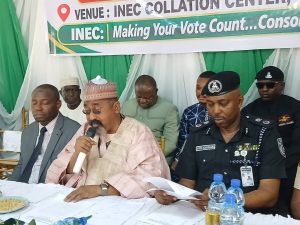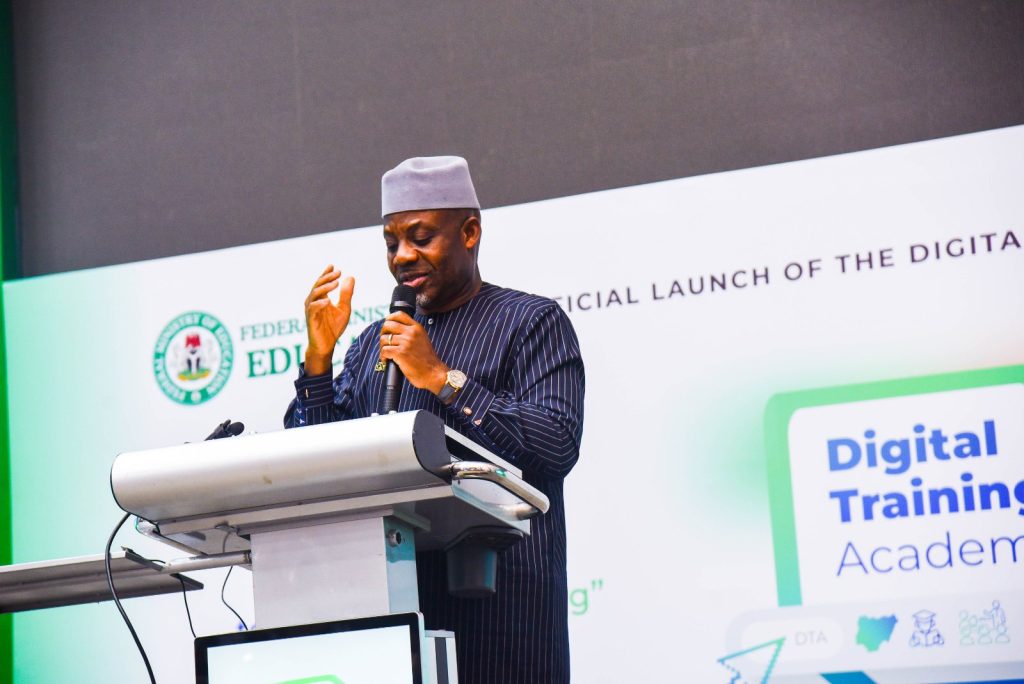
Minister of Education, Tunji Alausa
One of the most significant pillars of the Federal Government’s education reform agenda under the Minister of Education, Dr. Tunji Alausa, is the expansion of student financing through the Nigerian Education Loan Fund (NELFUND).
The initiative is aimed at ensuring that financial hardship no longer prevents qualified students from accessing higher education. According to official figures, more than 1.1 million students have benefited from the scheme, with over ₦191 billion disbursed to students across more than 320 tertiary institutions nationwide.
The policy is built on a simple principle: no Nigerian should be denied access to education because of poverty.
From Degrees to Skills: Expanding TVET
Another major focus of Alausa’s reforms is the expansion of Technical and Vocational Education and Training (TVET), reflecting the government’s determination to equip young Nigerians with practical skills needed in today’s economy.

The programme has generated remarkable interest, attracting about 1.3 million applications within just 10 days of its launch. Hundreds of thousands of young people are expected to benefit, while substantial government funding has been committed to expanding training opportunities across the country.
The emphasis is on practical skills, entrepreneurship, technology and employability to prepare graduates for the demands of a rapidly changing labour market.
Medical education has also received increased attention through investments in laboratories, simulation centres, student hostels and other critical infrastructure aimed at improving the training of healthcare professionals.
Modernising the Curriculum
Curriculum reform remains another key component of the minister’s agenda.
The Federal Government is reviewing the basic education curriculum to eliminate unnecessary duplication while placing greater emphasis on practical learning, critical thinking, digital literacy and skills development.
The objective is to move away from an education system driven largely by memorisation and examinations towards one that prepares learners for innovation, technology and the realities of the modern economy.
Teacher quality has equally received priority through efforts to strengthen the Teachers Registration Council of Nigeria (TRCN) and improve professional certification for teachers.
Recognising the growing impact of technology, the ministry has also established an Artificial Intelligence in Education Task Force. Thousands of secondary school teachers are being trained to understand and integrate artificial intelligence into classroom teaching.
In addition, the ministry is implementing an ICT blueprint in partnership with the French Government and the French Development Agency (AFD), while digital initiatives such as the Teacher Information Management System (TIMS) and the Tertiary Institution Information Management System (TIIMS) are expected to improve institutional administration, learner tracking, certificate verification and reduce certificate fraud.
Connecting Nigerian Education to Global Expertise
Another important initiative is the BRIDGE Programme—Bridging Research, Innovation, Development and Global Expertise.

The programme seeks to leverage the knowledge and experience of Nigerians in the diaspora by connecting them with universities and research institutions at home. Through research partnerships, mentorship, guest lectures, curriculum development and technology transfer, diaspora professionals are expected to contribute to Nigeria’s education sector without necessarily relocating permanently.
Other Key Reforms
The ministry has also introduced several policy changes aimed at widening access to education. Among them is the removal of JAMB admission requirements for candidates seeking admission into the Nigeria Certificate in Education (NCE) programme.
Similarly, the government has removed the compulsory Mathematics requirement for admission into non-science-related courses, a move intended to broaden access while maintaining standards in relevant disciplines.
These initiatives complement the broader reforms already underway across the education sector.
A Reform Agenda Under Close Watch
For Dr. Alausa, the goal is to build an education system that delivers results across the entire learning cycle—from basic education to tertiary education, technical training and workforce development.
His reforms seek to ensure that Nigerian graduates possess the knowledge, practical skills and competencies required to compete in both the local and global economy.
Beyond managing a ministry, the minister is overseeing an ambitious effort to transform how education is funded, how teachers are trained, how institutions are managed and how students are prepared for the future.
As Nigeria marks its 66th Independence Anniversary, the education reforms championed by Dr. Tunji Alausa present an ambitious vision for the sector. Ultimately, however, the success of the agenda will be measured not only by policies and announcements, but by their effective implementation, sustainability and the tangible improvements they bring to learning outcomes and national development.