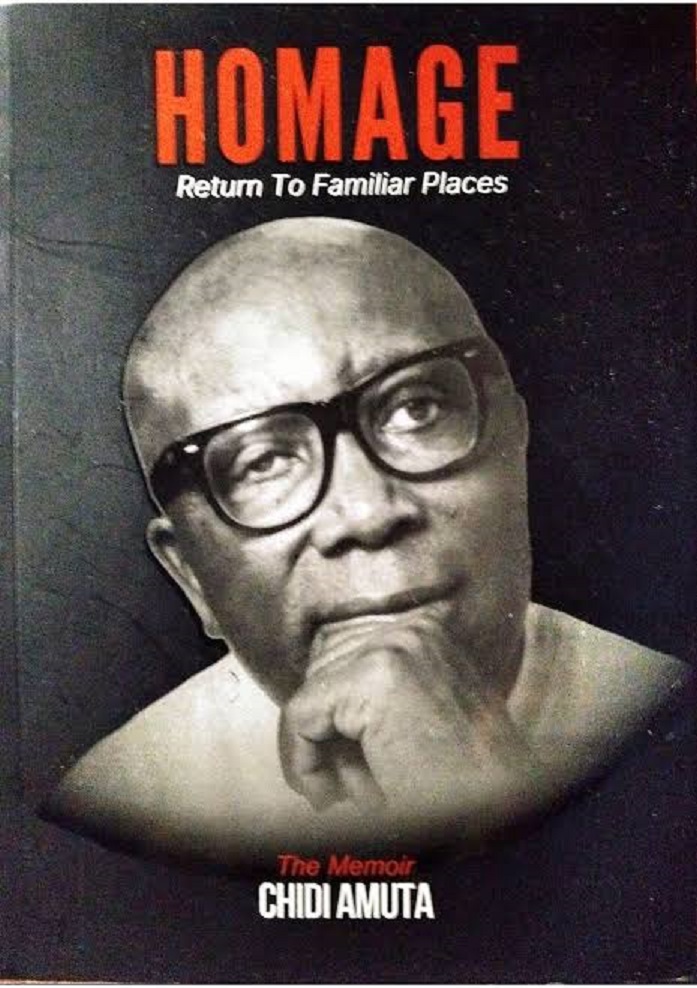
By UZOMA NWEKE, University of Jos –
Chidi Amuta’s just released memoir, HOMAGE, is remarkable in one respect. It projects Nigeria’s national history from the perspective of an individual’s personal life experience. The book is not just the way the author’s life reflects Nigerian history from pre-independence, independence, political crises, civil war and the resultant national reintegration. It is also an attempt to judge that history and seek to interrogate the presiding successive leadership.
Given the overt political tinge of the autobiography, it is understandable that Amuta devotes the concluding section of the book to a quest and reflections on what he terms “the Nigerian ideal”. It is a series of reflections on the various aspects of the contemporary national problem. He reflects on the hopes of independence. Through the eyes of a child, he recalls the hopes that presaged independence. To the innocent mind of rural folk, independence was presented as an invitation to paradise. Colonialism was an experience in bondage and the prospect of independence was presented as the coming of a ‘new Jerusalem’. Yet even in the eyes of a child, certain features of the independence movement suggested some contradictions: the alienation of the new political elite from the masses of the hopeful, the utopian presentation of the post -independence era and the rapid transformations of the coming era.
Even in spite of the inherent cynicism of the narrative, the author admits the positives of the colonial experience. The social services of education, water supply, power and urban sanitation were efficiently delivered. Governance was efficient even if the benefits mostly accrued to the colonial metropolis.
In a subsequent pseudo-satirical chapter, “Metaphor of the Leaning Tower”, Amuta dwells on the anachronisms and contradictions of Nigeria’s contemporary society. Amuta seemingly accepts the irregularities of the Nigerian situation as inherently attractive in themselves. He likens Nigeria’s perennially inclined reality as the main object of the nation’s attractiveness. Outsiders and locals alike have developed an addiction to a nation that is perennially on the incline but never collapses. It is that curiosity about Nigeria’s strange resilience in disrepair that keeps attention glued to the nation. Disrepair has become both a tourist attraction an an economic proposition, thus making Nigeria a permanently enticing destination for both tourists and fortune seekers.
The concluding section of this unusual memoir dwells on the troublesome issue of the “Nigerian ideal”, Over time, this has remained a troublesome issue. The Nigerian elite has hardly struck a consensus as to what should be the Nigerian ideal. To some, it is unity in diversity. To others, it is about the sharing of the infinite oil and gas national cake of royalties. To yet other, it is the nebulous idea of the largest black nation on earth.
In Amuta’s view, none of these popular conceptions adequately captures the Nigerian ideal:
“Nigeria was never intended to be an extractive colony. .. It was never designed to be a platform for sharing the nation as an endless resource cake and booty pot…Nor was Nigeria intended as a house divided and set upon itself. This place was not meant as a canvas for endless blood letting, a place where citizens would be locked in endless bloody battles over nothing in particular.” P.390.
Out of the outlines of a turbulent past, Amuta insists that Nigeria was indeed intended as a “place of pride for the black race. Nigeria was to become a melting pot for divergent peoples and cultures…Out of the diversity of divergent tongues and ways, an uncommon melting pot was expected to emerge…” p.392.
Beyond this abiding note of optimism about Nigeria’s potentials and promise, Amuta frequently relapses, as he does in his columns, into disappointment about the failures of the Nigerian state to actualize the hopes of its numerous citizens. He lays the blame squarely at the doorstep of successive leadership elite.
“ in all, we failed the nation. We failed our children. We failed the world that greeted the birth of Nigeria with high expectations. We betrayed a sacred promise made at the hour of hope…” p.393,
In spite of its sombre and often depressingly sad tone, this memoir emerges at the end as an optimistic private expression of national hope. “A new nation is possible…Its foundations and ingredients lie buried in the bowels of our current pains and the blessings of our resources…In that new place, our memories will no longer be anguished cries about a life time wasted in waiting for futile hopes…”
p..394. Interestingly, he accepts the collective generational responsibility for Nigeria’s condition. He avoids the distance of the writer but instead submerges himself in the responsibility for the burden of national guilt.
In seeking to advance a credible template and perspective of the Nigerian ideal, Amuta constantly laments the present bad state of the Nigerian state. Violence, insecurity, economic hardship, injustice, and hopeless governance are recurrent theme of the entire nearly 500-page memoir. The lost ideals and desirable features of his ideal Nigeria are classic ones. Diversity, inclusiveness, equity and justice for all. For him, it is the progressive erosion of these qualities over time that he laments as the tragedy of the Nigerian present.
The open question that this memoire raises by a ruse is in fact whether Nigeria had ever achieved these ideals as envisaged and articulated by the founding fathers and hinted at by occasional patriotic leaders. This is open to question. There have been isolated flashes of these ideals in the work of a few leaders and the rhetoric of idealistic patriotic individuals.
In the closing paragraphs of this unusual book, Amuta rises above the limited duty of a personal egocentric narrative to a definitive affirmation of national positivity and optimism. The abiding strength of HOMAGE is therefore the ability of the author to elevate the narrative a personal journey to a treatise on national history and nation being.