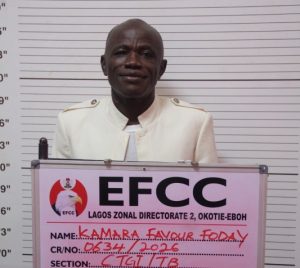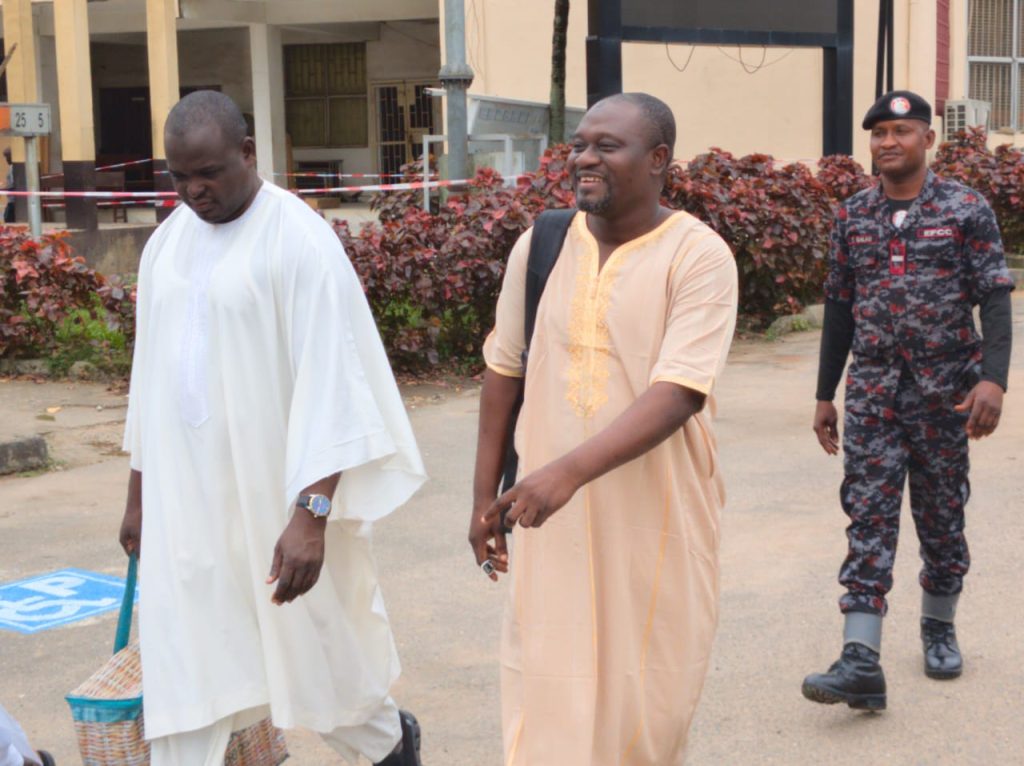
The Lagos Zonal Directorate 1 of the Economic and Financial Crimes Commission (EFCC), on Friday, September 4, 2026, arraigned Ali Bala and Yusuf Umar Anka before Justice Olukayode Ogunjobi of the State High Court sitting in Ikeja, Lagos, for an alleged £110,000 and ₦500 million fraud.
The defendants are standing trial on a 10-count charge bordering on money laundering, stealing, and retention of stolen property.
One of the counts reads: “That you, ALI BALA (a.k.a. Barrister Ahmed) and YUSUF UMAR ANKA, sometime in 2025 in Lagos, within the jurisdiction of this Honourable Court, conducted financial transactions involving proceeds of your unlawful activities to disguise the source of the stolen £110,000.00 (One Hundred and Ten Thousand Pounds Sterling), and thereby committed an offence contrary to Section 7(1)(b)(i) of the Advance Fee Fraud and Other Fraud Related Offences Act, 2006.”
The defendants pleaded “not guilty” to the charge.
In view of their pleas, prosecution counsel, H.U. Kofarnaisa, requested for a trial date and urged the court to remand the defendants in a correctional facility.
Defence counsel, however, informed the court of a pending bail application.
In his ruling, Justice Ogunjobi adjourned the matter to September 8, 2026, for the hearing of the bail application, and ordered that the defendants be remanded in EFCC custody pending the hearing.
At the 26th Extraordinary Session of the Executive Council of the African Union in Luanda, Angola, convened on the theme, “Strengthening Mechanisms for Conflict Prevention and Resolution in Africa”, Nigeria called on the African Union (AU) to explore innovative and sustainable financing mechanisms to strengthen the continent’s capacity to prevent and resolve conflicts and reduce dependence on external funding.
During my presentation on behalf of the Federal Republic of Nigeria, we commended the progress made in strengthening the AU Peace Fund, noting that member states had collectively contributed about 400 million capitalisation target, while the Fund’s balance had exceeded $`405 million.
The disbursement of about `$39 million for mediation, preventive diplomacy, peace support operations and other interventions demonstrates the Fund’s growing role in addressing Africa’s peace and security challenges.
African-led peace operations require predictable and reliable financing for personnel, logistics, equipment and other operational needs, and uncertain funding could undermine their effectiveness, hence the need for member states to continue to honor their assessed contributions, viewing these not merely as obligations but as investments in our collective security and sovereignty.
It is important that the African Union moves from dependence on external assistance towards greater African self-reliance, even as international partners continue to play an important role in supporting peace and security on the continent.
External assistance should complement African ownership; it should not substitute for it. African resources should remain the foundation of African peace and security financing.