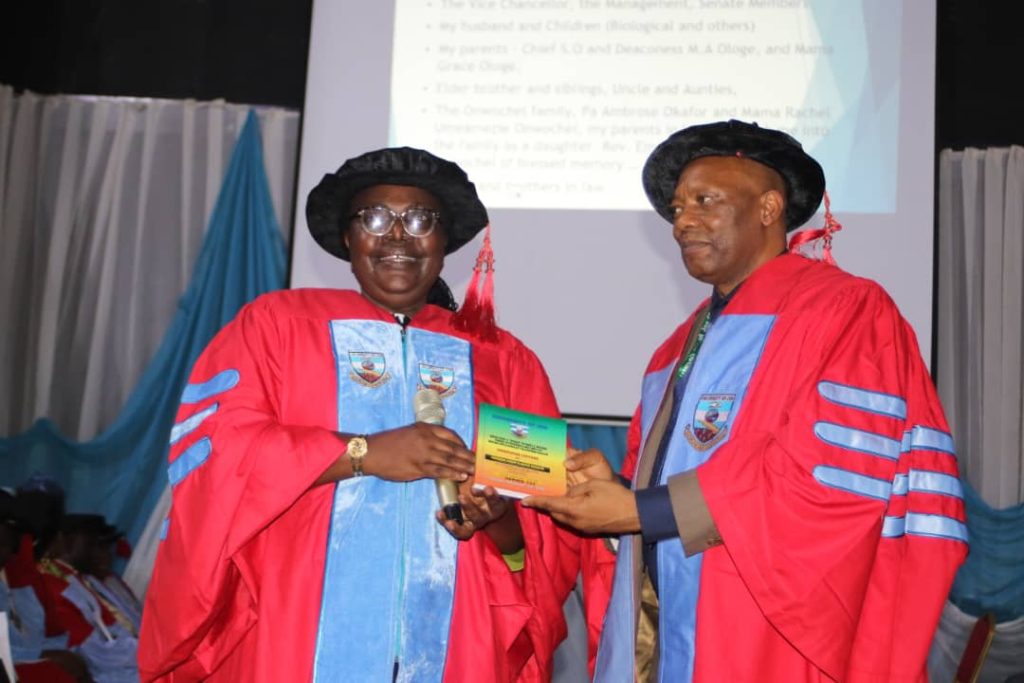
A Professor of Phonetics and Phonology at the University of Jos (UNIJOS), Prof. Modupe Olubunmi Onwochei, has disclosed that Nigerian speakers were more intelligible to British listeners in many instances than native English speakers were to Nigerians.
Onwochei disclosed this on Tuesday while delivering the 131st inaugural lecture of the University of Jos, titled, “ When Your L1 ‘Speaks’ in Your L2: Mother Tongue Interference and the Limits of Mutual Intelligibility in Nigerian English.”
She said her previous research on intelligibility involved 100 respondents, comprising 50 Nigerians and 50 native English speakers, with about five tests administered to examine both speech production and perception.
“From my previous research, I had one on intelligibility level between the native speaker and non-native. I had 100 respondents, 50 Nigerians and 50 native speakers, and we had about five tests administered.
“And in doing this, we recorded the test because we tested production and perception — that is, what you say and what we hear,” she said.
The professor explained that the recorded tests were taken to the United Kingdom and administered to native English speakers, while similar tests were conducted among Nigerian participants.
According to her, the participants were asked to write down words they heard from the recordings, adding that the findings produced an outcome that challenged assumptions about the intelligibility of Nigerian English.
“The update on the finding was shocking. We realised, or we discovered, that the Nigerian speakers were more intelligible to the British in many instances, while our L1 speakers understood the British people at 54-something per cent,” Onwochei stated.
She attributed the differences in understanding to segmental and suprasegmental features of speech, among other factors.
Onwochei said the findings also reinforced the need to reconsider the way mother tongue influence on Nigerian English was viewed, arguing that such influence should not automatically be regarded as bad English, errors or mistakes.
“For too long, we have called these interference. We have called it bad English. We have also called it errors and mistakes. Let us call it by the proper name: transfer. We would rather call it transfer than mistakes and errors.
“Let us describe it. Let us study it. Let us not see it as a problem to be erased, but as something to be understood and managed,” she emphasized.
She explained that Nigerian English had been “reshaped, rearranged and reorganised” by indigenous languages, noting that her lecture examined the influence of Hausa, Igbo, Yoruba, Berom, Jukun and Fulfulde on the English language in Nigeria.
According to her, mother tongue transfer could occur at the phonological, syntactic, lexical and pragmatic levels, with differences in the sound systems of indigenous languages sometimes affecting the way English words were pronounced.
The don therefore called for a balanced approach to English-language teaching, urging educators to teach standard English while recognising Nigeria’s multilingual environment.
“We must teach the standard. There are two standards as we are here. We have Standard British English, isn’t it, and Nigerian English. Let us know it. Let us understand it. Let us know when and where to use it,” she said.
Earlier, the Vice-Chancellor of the university, Prof. Tanko Ishaya, described the inaugural lecture as an important academic tradition through which professors share their research and scholarship with the wider university community.
Ishaya noted the relevance of the lecture to Nigeria’s linguistic environment, particularly the influence of mother tongues on the way Nigerians communicate in English, and expressed hope that it would contribute to discussions on language development and policy in the country.