Prof Moti
The Handover Statement
There is another important piece of evidence in the debate: the financial information associated with Peter Obi’s handover. A document presented as Obi’s March 2014 handover financial summary reportedly identified local investments of approximately ₦27 billion, foreign-currency investments of about US$156 million, certified State and MDA balances of approximately ₦28.166 billion, a Federal Government-approved refund of about ₦10 billion and estimated liabilities of approximately ₦5 billion. The resulting net balance was presented at approximately ₦86.666 billion. But there appears to be a significant limitation.
The document does not provide a comprehensive debt schedule setting out each external and domestic loan, its outstanding principal, its maturity, its repayment obligations and the amount disbursed as at the date of handover. This creates an important evidentiary problem. The handover statement cannot, by itself, establish that Anambra was completely debt-free. At the same time, its failure to provide a detailed debt schedule does not prove that Peter Obi handed over the US$123.77 million now being cited by the Soludo administration. Both conclusions would go beyond what the document establishes.
The Question of Salaries, Pensions and Gratuities
The debt question should also be distinguished from the separate issue of unpaid salaries, pensions, gratuities and other inherited liabilities. The Soludo administration has stated that it identified legacy liabilities involving, among others, Water Corporation workers and primary-school teachers. It has also stated that approximately ₦22 billion in inherited gratuity arrears has been paid. The administration has further alleged that 16 months of teachers’ arrears had been verified during the Obi period, while only five months were paid. These are serious claims and deserve proper scrutiny. But again, political assertions should not substitute for documentary reconciliation.
The appropriate evidence would include payroll records, pension records, government liability registers, court judgments where applicable, verification reports, payment vouchers, Treasury records and, critically, the dates on which each liability arose and the dates on which it was eventually settled. A liability that originated under an earlier administration should not automatically be classified as an Obi-era liability merely because it remained unpaid during Obi’s tenure.
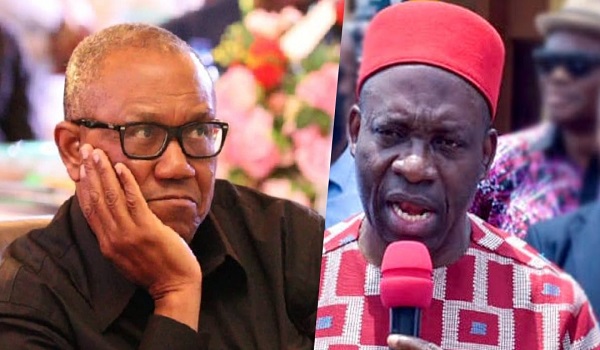
- OBI and SOLUDO
Conversely, if Obi’s administration formally verified a liability and accepted responsibility for it but failed to settle it before leaving office, that would be relevant evidence against an absolute claim that he left no liabilities. The principle is the same: establish the date, establish the liability, establish the responsible institution, and establish what was actually paid.
The ₦2.13 Billion Ecological Fund Question
The controversy surrounding the alleged ₦2.13 billion ecological fund should also be treated separately. Peter Obi has reportedly claimed that more than ₦2.13 billion associated with ecological funding was left in a First Bank account. The Anambra Government says that the account it examined was actually an IGR consolidated revenue account and that its certified statement did not show the claimed ₦2.13 billion balance. This is not a matter that should require endless political argument. It is fundamentally a documentary question. The relevant question is: What was the certified balance in the relevant account at the close of business immediately before or on the date of handover, and what was the source and legal designation of those funds?
If the Soludo administration possesses the certified bank statement, it should publish the relevant evidence, subject to appropriate redaction of sensitive banking information. If Peter Obi possesses documentary evidence demonstrating that the funds existed in another account, were transferred, or were classified differently, that evidence should equally be placed in the public domain. A bank statement is more useful to the public than a political press conference.
The US$4.05 Billion Expenditure Claim
The Anambra Government has also reportedly stated that the Obi administration spent approximately US$4.05 billion over eight years and has converted that figure to approximately ₦5.4 trillion at today’s exchange rate. Again, the methodology deserves explanation. The government says it arrived at the dollar figure by using historical average official exchange rates to convert audited expenditure figures and then translated the aggregate dollar figure into today’s naira. That may be a legitimate analytical exercise if properly documented. But it is not the same thing as saying that Anambra State actually spent ₦5.4 trillion in nominal naira between 2006 and 2014.
The ₦5.4 trillion is essentially a contemporary naira equivalent produced through a conversion methodology. It should not be presented as though it were the historical nominal expenditure recorded in Anambra’s accounts. A more informative public-finance presentation would provide annual expenditure in nominal naira, expenditure adjusted for inflation where relevant, the recurrent-capital composition, expenditure as a proportion of annual revenue and, where relevant, debt-service obligations. Otherwise, a large converted headline number can create an impression of historical spending that is not directly comparable with the state’s actual budgetary accounts at the time.
So, Has Soludo Proved That Obi Left Debt?
The answer should be neither a political “yes” nor a political “no.” The evidence supports a more precise conclusion. There is evidence from the Debt Management Office that Anambra had public debt around the end of Peter Obi’s tenure. In December 2013, the DMO recorded approximately US$30.32 million in external debt and approximately ₦3.03 billion in domestic debt. There is also evidence that eight development-financing facilities associated with projects undertaken during the Obi period had original commitments totalling approximately US$123.77 million.
There is evidence, according to the figures published by the present administration, that approximately US$92.35 million remained outstanding against those facilities as at June 30, 2026. What those facts do not establish, without a more detailed reconciliation, is that Peter Obi handed over US$123.77 million or ₦127.37 billion in outstanding debt on March 17, 2014. Nor do they establish that every naira of the 2026 outstanding balances should be attributed to Peter Obi personally. Equally, Peter Obi’s blanket assertion that he left Anambra with absolutely no public debt is difficult to reconcile with the contemporaneous DMO records. That is the uncomfortable truth for both sides.
What Nigerians Should Demand
The way out of this controversy is not another round of political accusations. It is a transparent reconciliation of the numbers. The Anambra State Government should publish, for each of the eight facilities: the facility name; the date it was approved; the date the agreement was signed; the original commitment; the amount actually disbursed; the amount disbursed as at March 17, 2014; the amount still undisbursed at that date; the principal outstanding on March 17, 2014; interest and other charges; repayments made during the Obi administration; repayments made during the Obiano administration; repayments made under subsequent administrations; and the balance outstanding as at June 30, 2026. Such a table would immediately resolve much of the argument. The same principle should apply to the alleged salary, pension and gratuity arrears.
For each liability, the public should be told: when the liability arose; under which administration; the amount verified; the amount paid; the amount outstanding at handover; and the administration that subsequently settled it. For the alleged ₦2.13 billion ecological fund, the relevant certified bank records should be produced. For expenditure, annual audited figures should be presented in historical naira alongside any dollar or current-naira conversion, with the methodology clearly explained. That is how a serious society handles public finance.
Beyond Obi and Soludo
There is a danger in allowing this debate to become another chapter in Nigeria’s familiar politics of personalities. The issue is larger than Peter Obi. It is larger than Willie Obiano. It is larger than Chukwuma Soludo. The real question is whether Nigerians are prepared to demand a higher standard of evidence when public officials make claims about public money.
Every incoming administration inherits assets and liabilities. Every outgoing administration leaves behind contracts, projects, debts, receivables, contingent liabilities, court judgments, pension obligations and development-financing arrangements. Without a standardised and independently verified handover system, every new administration can selectively interpret the financial legacy of its predecessor. One administration can say it inherited a treasury. Another can say it inherited a mountain of debt. Both may be drawing from different components of the same balance sheet. This is why public accountability cannot depend on political narratives alone.
The Evidence-Based Position
The most defensible conclusion from the evidence presently available is therefore straightforward: Anambra had public-debt obligations around the end of the Peter Obi administration. The state also entered into or participated in development-financing arrangements connected with projects initiated during that period, some of which remain outstanding today. However, the figures currently published by the Soludo administration do not, by themselves, establish that Peter Obi handed over ₦127.37 billion, or US$123.77 million—in outstanding debt on March 17, 2014. The US$123.77 million is the aggregate original value of the identified facilities. The US$92.35 million is the reported outstanding balance in 2026. The ₦127.37 billion is a 2026 Naira equivalent of that reported balance. None of those numbers, without further reconciliation, is the same as the March 17, 2014 debt stock.
At the same time, Peter Obi’s categorical assertion that he left Anambra completely debt-free is difficult to reconcile with the DMO’s December 2013 records. The responsible conclusion, therefore, is not to declare one political side the winner. It is to insist that the historical debt position be established through primary records.
The Number Nigerians Should Be Asking For
The most important number in this debate is neither ₦127 billion nor US$123.77 million. It is: What was Anambra State’s actual outstanding public debt on March 17, 2014? That is the number that would directly answer the question at the centre of the controversy. It should be accompanied by the underlying evidence. Until that reconciliation is published, Nigerians should be cautious about accepting either extreme narrative, that Peter Obi left Anambra completely debt-free, or that he handed over a ₦127 billion debt burden. The evidence currently supports neither extreme.
What it supports is something more useful for a democracy: Anambra had debt; some of the obligations associated with projects from the Obi era remain outstanding; but the precise debt inherited by Willie Obiano on March 17, 2014 has not yet been transparently demonstrated by the figures now being presented. That distinction may not make the most dramatic political headline. But it is the distinction that matters in public finance.
If Nigeria is serious about improving governance, the public conversation must move from “Who is right?” to: Show us the audited numbers, the dates, the agreements, the disbursements, the repayments and the balance sheet. That is how political claims become public knowledge. That is how accountability should work. That is how citizens can distinguish between a financial fact, a financial interpretation and a political narrative.
Concluded