
Prof Moti
The latest controversy over the financial legacy of former Anambra State Governor Peter Obi has once again demonstrated how easily public finance can become entangled in political narratives. Numbers are being deployed as weapons, headlines are competing with counter-headlines, and Nigerians are being invited to choose between competing versions of the past.
The latest intervention by the Anambra State Government, under Governor Chukwuma Soludo, is particularly significant. The government has published details of eight external financing facilities which it says were contracted in connection with projects undertaken during Peter Obi’s administration. According to the figures released, the original value of the facilities was approximately US$123.77 million, while about US$92.35 million was still outstanding as at June 30, 2026. The state translates the latter into approximately ₦127.37 billion.
The publication has consequently been presented in some quarters as proof that Peter Obi left Anambra with a substantial debt burden. But does it actually prove that? The answer requires considerably more nuance than the political rhetoric surrounding the issue. I have decided to do a modest analysis of the presentation from the perspective of a public sector and governance expert for public education beyond the politics of figures, what the evidence tells us about Peter Obi, Willie Obiano and Anambra’s inherited liabilities. This analysis is limited because it relies on documents and figures presented by Peter Obi and the Soludo administration as well as the Debt Management Office.
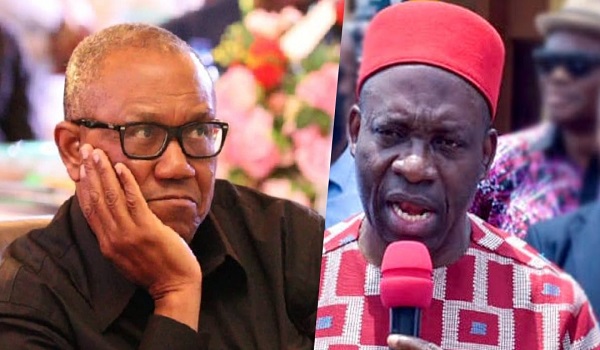
- Obi and Soludo
There is credible evidence that Anambra had public-debt obligations around the end of Peter Obi’s tenure. There is also credible evidence that financing facilities associated with projects undertaken during his administration remain outstanding today. What has not been established by the figures presently published, however, is that Peter Obi handed over ₦127 billion—or US$123.77 million—in outstanding debt to his successor in March 2014. That distinction is not semantic. It is fundamental to sound public-sector accounting.
What has the Anambra Government actually established?
The Anambra State Government has identified eight financing facilities which it associates with projects initiated during the Obi administration. The facilities include the Malaria Control Booster, with an original facility of approximately US$9.46 million and a reported balance of about ₦6.18 billion; the Third National Fadama III project, originally about US$7.17 million, with approximately ₦6.03 billion outstanding; the Health System Development II facility of approximately US$4.12 million, with about ₦2.81 billion outstanding; and the Malaria Control Additional Financing facility of approximately US$4.42 million, with about ₦4.37 billion outstanding.
The State Education Programme Investment Project, or SEPIP, is listed at approximately US$48.33 million originally, with a reported outstanding balance of about ₦51.50 billion. The Community and Social Development Project is listed at approximately US$4.84 million, with about ₦5.10 billion outstanding. The Nigeria Erosion and Watershed Management Project, or NEWMAP, is listed at approximately US$37.89 million, with approximately ₦48.08 billion outstanding. Finally, the Value Chain Development Project is listed at approximately US$7.50 million, with about ₦3.27 billion outstanding. Taken together, these facilities amount to approximately US$123.77 million in original commitments. The state says approximately US$92.35 million remains outstanding as at June 30, 2026.
There is therefore a factual basis for saying that Anambra has external financing obligations associated with development projects initiated during the Obi era and that some of these obligations remain outstanding. But that statement is very different from saying that Peter Obi handed over ₦127 billion in debt to Willie Obiano in March 2014. The distinction is critical.
The Problem of Dates
Perhaps the most important weakness in the current presentation is the mismatch between the date of the political claim and the dates of the financial figures being used to support it. The political question concerns Peter Obi’s financial position at the point at which he left office on March 17, 2014. The Anambra Government’s presentation, however, juxtaposes the original values of financing facilities with balances reportedly outstanding as at June 30, 2026. Those are three different points in time.
An original loan commitment is not necessarily the same as the amount disbursed. The amount disbursed is not necessarily the same as the amount outstanding. And the amount outstanding in 2026 cannot automatically be assumed to be the amount outstanding in March 2014. Consider a simple example. If a state signs a US$50 million development facility but only US$10 million has been disbursed by the date a governor leaves office, it would be misleading to say that the governor left behind US$50 million of outstanding debt.
Similarly, if additional funds were subsequently disbursed, while successive administrations repaid portions of the principal, the balance remaining in 2026 cannot simply be attributed wholesale to the governor who was in office when the original facility was initiated or signed. This is why public debt analysis must distinguish between the original commitment, actual disbursement, outstanding principal and the date on which the liability is being measured.
What does the Debt Management Office say?
The controversy becomes even more interesting when the official records of the Debt Management Office (DMO) are brought into the discussion. The DMO’s records show that as at December 31, 2013, Anambra State had external debt of approximately US$30.323 million. The DMO’s records also show domestic debt of approximately ₦3.026 billion at the same date. The external debt figure is specifically recorded at approximately US$30.323 million, while the revised domestic-debt record puts Anambra’s domestic debt at approximately ₦3.026 billion. Peter Obi did not leave office until March 17, 2014.
These figures therefore make it difficult to sustain an absolute proposition that Anambra had no public debt whatsoever around the time he left office. But there is an equally important qualification. December 31, 2013 is not March 17, 2014. The DMO figures establish the position at the end of 2013. They do not, by themselves, provide the precise debt stock on the day Peter Obi handed over power. That distinction is precisely the kind of distinction that should characterise responsible public discussion.
The June 2014 DMO Figure
There is another DMO figure that deserves attention. The DMO’s external-debt record for June 30, 2014 puts Anambra’s external debt at approximately US$41.46 million. But Peter Obi had already left office in March. Consequently, it would be equally problematic to attribute the entire June 2014 figure to Peter Obi. The June figure could reflect debt that existed before March; disbursements made before March; disbursements made after March; exchange-rate effects; accounting adjustments; or other changes in the debt stock. The point is simple: a June 2014 debt figure cannot automatically be presented as Peter Obi’s March 2014 handover debt. What is required is the debt position on March 17, 2014.
What kind of loans are we talking about?
Another important dimension that has received insufficient attention in the political debate is the nature and structure of the financing facilities. Several of the projects identified by the Anambra Government were development-partner programmes implemented through Nigerian states. They were not necessarily conventional commercial loans personally negotiated by a governor for unrestricted state spending. The World Bank documentation on the State Education Programme Investment Project, for instance, describes a US$150 million credit to the Federal Government of Nigeria, with resources subsequently disbursed to participating states, including Anambra, through subsidiary financing arrangements.
The same broad principle applies to projects such as the Nigeria Erosion and Watershed Management Project. NEWMAP was a national, multi-state programme financed through an International Development Association facility to the Federal Republic of Nigeria, with participating states, including Anambra, benefiting from the programme. This does not mean that Anambra has no repayment obligation. If Anambra entered into subsidiary financing arrangements under which it was required to repay funds, then that obligation is a genuine state liability. But there is an important difference between saying that AnamFederal repbra incurred obligations under World Bank-supported development financing arrangements and saying simply that “Peter Obi borrowed US$123.77 million.” The latter formulation obscures the financing structure, the role of the Federal Government, the participating state, the timing of disbursement and the terms under which the liability became payable. Public education demands that these distinctions be maintained.
What exactly Does the US$123.77 Million represent?
The phrase “US$123.77 million in debt” also requires careful interpretation. From the published figures, the US$123.77 million appears to represent the aggregate original values of the eight facilities identified by the Anambra Government. That is not necessarily the same as: the amount actually disbursed; the amount drawn before March 17, 2014; the principal outstanding on March 17, 2014; the total liability inherited by the Obiano administration; or the total amount eventually repayable by Anambra State. These are different financial concepts.
In public finance, loan approval is not the same thing as loan agreement; loan agreement is not the same thing as disbursement; disbursement is not the same thing as outstanding principal; and outstanding principal is not necessarily the same thing as total debt-service obligation. The public debate becomes distorted when these categories are collapsed into one headline figure.
And what about the ₦127.37billion?
This may be the most politically powerful. and potentially the most misunderstood, number in the current debate. The Anambra Government says approximately US$92.35 million remains outstanding as at June 30, 2026 and translates this into approximately ₦127.37 billion. Mathematically, there may be nothing inherently wrong with converting a dollar-denominated liability into naira at a specified exchange rate. The problem arises when the resulting figure is interpreted as though it were the amount Peter Obi handed over in 2014. It was not. It is a 2026-naira equivalent of an outstanding balance reportedly existing in 2026. It does not establish that ₦127.37 billion was the debt stock in March 2014. Indeed, ₦127 billion in 2026 does not have the same purchasing power or economic meaning as ₦127 billion would have had in 2014.
Exchange-rate movements further complicate the comparison.
A dollar-denominated loan can remain substantially unchanged in dollar terms while its naira equivalent increases dramatically because of currency depreciation. Conversely, repayments may reduce the principal while exchange-rate movements increase the naira equivalent of the remaining balance. This is why a serious debt analysis should always state both the foreign-currency balance and the relevant exchange rate, while also identifying the date of the balance.
The Peter Obi Handover Statement
There is another important piece of evidence in the debate: the financial information associated with Peter Obi’s handover. A document presented as Obi’s March 2014 handover financial summary reportedly identified local investments of approximately ₦27 billion, foreign-currency investments of about US$156 million, certified State and MDA balances of approximately ₦28.166 billion, a Federal Government-approved refund of about ₦10 billion and estimated liabilities of approximately ₦5 billion. The resulting net balance was presented at approximately ₦86.666 billion. But there appears to be a significant limitation.
… To be continued