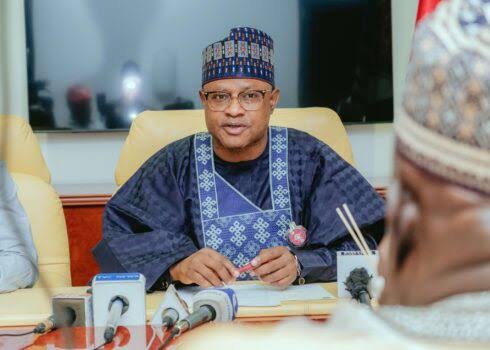
Kaduna State Governor, Uba Sani
Kaduna State Government has explained the rationale behind Governor Uba Sani’s decision to allocate ₦100 million to each of the state’s 255 wards in the 2026 budget, describing the move as a historic and deliberate push to entrench grassroots development.
The Commissioner for Planning and Budget, Mukhtar Ahmed Morovia, gave the explanation during a post-budget press briefing, shortly after the Governor signed the ₦985.9 billion 2026 Appropriation Bill into law.
Morovia said the ward-based allocation, the first of its kind in the state’s history, reflects Governor Uba Sani’s commitment to inclusive governance, community participation and balanced development across Kaduna State.
He disclosed that ₦698.9 billion, representing 70.9 per cent of the total budget, has been earmarked for capital expenditure, with focus on infrastructure, economic growth and service delivery, while ₦287 billion (29.1 per cent) was allocated to recurrent spending to ensure efficient running of government.
According to the Commissioner, the ₦100 million per ward will be deployed to projects in the health, education, agriculture and social sectors, and will be implemented by relevant Ministries, Departments and Agencies (MDAs).
He stressed that the funds would be disbursed transparently, with communities determining their priority needs through their Ward Development Committees, in line with the Governor’s bottom-up development strategy.
“Governor Uba Sani understands that sustainable development must start from the grassroots. This allocation ensures that no ward and no community is left behind,” Morovia said.
Also speaking at the briefing, the Commissioner for Business Innovation and Technology, Mrs Patience Fakai, announced that the Institute of Vocational Training and Skills Development is now fully operational.
She said the development underscores the administration’s resolve to strengthen human capital development, adding that training under both Kaduna State–supported programmes and the Federal Government’s Technical and Vocational Education and Training (TVET) framework has commenced.
According to her, the institute has the capacity to train up to 32,000 students annually across 14 trade areas, positioning it as a critical driver of skills acquisition, employability and workforce readiness in the state.
On why the education sector received the largest share 25 per cent of the 2026 budget, the Commissioner for Education, Prof Abubakar Sani Sambo, said the decision aligns with UNESCO’s recommendation for developing countries.
He noted that Governor Uba Sani places premium on education as a catalyst for development, adding that UNESCO advises nations to devote about one-quarter of their budgets to education in order to achieve the Sustainable Development Goals (SDGs).
Commissioners present at the briefing included the Commissioner for Information and Culture, Ahmed Maiyaki; Commissioners for Education, Agriculture Finance and Agriculture; as well as Commissioners for Environment and Natural Resources, Business Innovation and Technology, Humanitarian Affairs, and Human Services and Social Development.