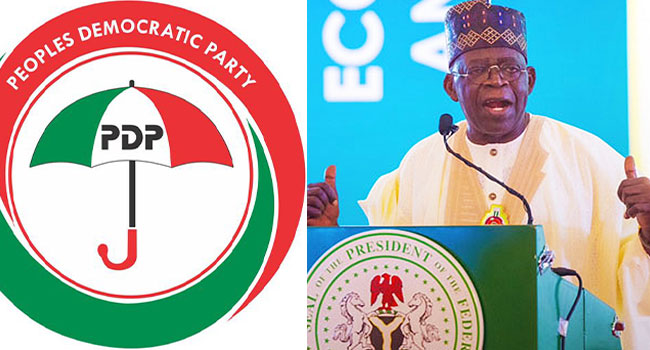
PDP logo and President Bola Tinubu
The Peoples Democratic Party (PDP) has strongly criticised President Bola Ahmed Tinubu’s Independence Day broadcast, accusing him of presenting a misleading picture of Nigeria’s economic situation and comparing his administration to the biblical Pharaoh rather than Moses.
In a statement issued on Friday, the opposition party said President Tinubu’s address portrayed his government as leading Nigerians from hardship to prosperity, but argued that the reality across the country tells a different story.
According to the PDP, millions of Nigerians are battling worsening economic conditions caused by policies introduced by the All Progressives Congress (APC)-led administration.
The party said the President’s message reflected the biblical story of the Israelites crossing the Red Sea, where his administration appeared to cast itself as Moses leading the people to freedom.
However, the PDP insisted that the country is instead passing through what it described as a “Red Sea of economic pain.”
The statement read: “The President issued his Independence Day message across different media platforms. The message mirrored the biblical journey of the Israelites through the Red Sea from Egypt, tactically casting the President and his administration as Moses, who is leading the nation from slavery to freedom. However, our reality reveals something different.”
The opposition party noted that although the Presidency admitted in the speech that poverty had risen before Tinubu assumed office in May 2023, many Nigerians now believe their living conditions have become even worse.
It quoted the Presidency as saying, “By 2023, poverty was rising, and hope was nearly gone. The country’s situation was darker than ever.”
The PDP added that the President’s appeal for Nigerians not to dwell on the past ignores the daily realities facing citizens.
According to the party, rising house rents, transport fares, school fees and food prices continue to place heavy pressure on families across the country.
The party also pointed to recent figures from the National Bureau of Statistics (NBS), noting that food inflation stood at 19.57 per cent in August 2026, while some states recorded food inflation above 35 per cent.
It argued that although the inflation rate slowed slightly, food remained beyond the reach of many households.
The PDP further criticised the high cost of borrowing despite the recent reduction in the Monetary Policy Rate from 26.5 per cent to 23 per cent, saying businesses are still struggling to survive.
It stated that government should focus on addressing the country’s economic challenges instead of promoting what it described as “skewed narratives.”
The statement further declared: “These facts lead to only one conclusion: that most Nigerians prefer where they were in 2019 to where this administration has put them today.”
The party accused the APC-led government of implementing policies that have increased hardship, insecurity, division and threats to democratic development.
Drawing another biblical comparison, the PDP said: “So clearly, Tinubu and the APC are the Pharaoh who is chasing Nigerians.”
Looking ahead to the 2027 general election, the opposition party urged Nigerians to vote for leaders capable of reversing the country’s current economic challenges.
It said: “As the elections approach in 2027, Nigerians will have an opportunity to elect their Moses, who should save them from the Pharaoh and the economic pain that they are currently facing.”
The PDP maintained that Nigerians are capable of judging the performance of the current administration and expressed confidence that voters would make informed decisions during the next election.
Since assuming office on May 29, 2023, President Tinubu’s administration has introduced major economic reforms, including the removal of fuel subsidy and the unification of the foreign exchange market. The Federal Government says the policies are necessary to rebuild the economy and attract investment, while opposition parties and labour groups argue that the reforms have significantly increased the cost of living for ordinary Nigerians.