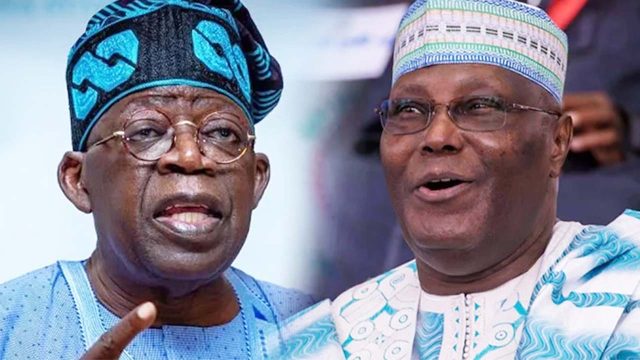
President Bola Tinubu and former VP Atiku Abubakar
The Presidency has criticised former Vice President Atiku Abubakar over what it described as conflicting positions on petrol subsidy, accusing the 2023 presidential candidate of sending mixed signals on a key economic policy.
In a statement issued on Wednesday, Special Adviser to the President on Information and Strategy, Bayo Onanuga, said Atiku’s recent comments on fuel subsidy had created uncertainty and raised questions about the credibility of his economic proposals.
According to Onanuga, Nigerians have been presented with three different explanations of Atiku’s position on petrol subsidy within a week, making it difficult to determine the policy he intends to pursue if elected president.
He noted that Atiku’s spokesman, Paul Ibe, initially said an Atiku administration would restore petrol subsidy temporarily before gradually phasing it out to ease the burden on Nigerians and businesses.
However, Onanuga said another senior aide, Phrank Shaibu, later distanced the former vice president from that position, describing it as “an unauthorised and misleading characterisation.”
Shaibu reportedly explained that subsidy removal would not be tied to a fixed timeline but would depend on improvements in domestic refining, supply stability, market competition and the ability of the petroleum market to provide affordable prices without government intervention.
The Presidency said Atiku later intervened and reaffirmed his original position, insisting that his stance had not changed.
According to Onanuga, Atiku stated: “I will restore targeted subsidy and put purchasing power back in the hands of Nigerians.”
The presidential spokesman argued that the varying explanations reflected a lack of policy consistency rather than a coherent economic strategy.
“This is not merely a matter of semantics. It is a serious policy contradiction,” Onanuga said.
“If Atiku’s position has not changed, why did one of his principal aides say the subsidy would be temporary and phased out? Why did another senior aide have to publicly disown that explanation and introduce a completely different framework based on market conditions? And why did Atiku then step in to reaffirm the original position?
“Nigerians deserve clarity, not policy by trial and error.”
Onanuga also rejected the argument that restoring fuel subsidy alone would significantly reduce the cost of living, stressing that petrol prices are influenced by several factors, including international crude oil prices, exchange rates, refining costs, transportation and distribution expenses.
He maintained that while competition could improve efficiency, it could not shield Nigeria from global market realities.
The Presidency further argued that rising food prices cannot be attributed solely to petrol costs, pointing out that food inflation persisted even during the years when fuel subsidy was in place.
According to Onanuga, agricultural productivity, insecurity, exchange rate volatility, logistics, flooding, storage challenges, production costs and money supply also play significant roles in determining food prices.
He said the Tinubu administration had been addressing these broader economic challenges rather than focusing only on petrol prices.
The Presidency challenged Atiku to provide details of his proposed targeted subsidy programme.
“We therefore urge Atiku to stop shifting positions and explain precisely what he means by ‘targeted subsidy’: how much will it cost, who will benefit, how will beneficiaries be identified, how will it be funded, and what objective economic conditions will determine its eventual termination?” Onanuga said.
He added that Nigerians deserved a transparent and costed policy rather than what he described as another potentially expensive subsidy regime under a different name.
Onanuga also questioned whether Atiku intended to subsidise other petroleum products derived from crude oil, including diesel, kerosene and aviation fuel, noting that these products had been deregulated by previous administrations.
“The economy is too serious for policy somersaults, incoherence, destructive populism and election gimmicks,” he said.
The Presidency maintained that the removal of petrol subsidy has improved fiscal revenues available to the federal, state and local governments while contributing to macroeconomic stability.